When Good Intentions Trigger Disordered Eating Behaviors. Who is at risk?

Last week my mom showed me a brochure that came in the mail a while back. The message on it was about foods that are better for your health versus foods that are not. It appeared to be written as a healthy eating piece to educate the public.

It seemed the audience they are trying to reach are folks who don’t eat too many fruits and vegetables every day. It might also include people who usually eat frozen meals at home or dine out at fast-food establishments.

On one side of the page, it says “Discover food secrets. At least one will surprise you.” Below it has an infographic about different fruits and vegetables and their health benefits—the superstars. When I first read it, the tone concerned me. The wording takes on an all-or-nothing approach.

Then I flipped the brochure over to the other side and saw the words, “We name names!” Below that heading, the body copy delves into food examples from a popular frozen food company and fast-food restaurants. Calorie amounts, sodium, sugar, and fat grams are listed for each food and beverage. The punitive tone was enough to make me, a practicing RD, cringe with guilt after seeing my favorite ice cream as one of the examples. It was called, “Extreme ice cream.” The paragraph goes on to describe how ice cream squeezes large amounts of calories and sugar into fat cells. Whatever that means. I don’t know about you, but when I want to enjoy dessert, that’s not something I want to think about. I certainly don’t want to feel guilty about my decision to enjoy ice cream, ever!

The brochure was created by a non-profit organization working for public interests. I do not doubt the good intentions. I visited the website and observed recipe books, magazines and newsletters. It’s very professional and appears creditable. They’re part of another larger organization that’s been around for a while. But I’m not going to divulge who they are. Bashing others who are working hard for the benefit of the public isn’t my goal. But I want to tell anyone who will listen, who doesn’t already know, that there are folks out there that won’t take this information the way it might be intended. After reading it, I see the potential for these words to be triggering for those who don’t feel good in their own body and are dealing with more than just a desire to eat healthier.

With the recent rise in disorder eating diagnoses, my experience with patients suffering from eating disorders compels me to give constructive criticism. These individuals often have negative thinking patterns which can lead to extremely unhealthy eating behaviors. Traditionally it was thought to be usually white females suffering from anorexia or bulimia, but people coming from every age, race, gender identity and sexual orientation represent a growing portion of individuals who are getting diagnosed with eating disorders. If you’re not too familiar with disordered eating, it’s more troublesome than you think. Taking the approach “just eat what I tell you and you’ll be fine” while pushing personal nutrition beliefs onto someone with an eating disorder can be more harmful than helpful.

When I was in college, this area of dietetics didn’t get enough attention. Students taking classes in nutrition don’t learn enough about disordered eating unless they had a specific interest in it. I remember eating disorders were only discussed during a lecture in one of my clinical nutrition courses. Later I learned some of my fellow students were engaging in unhealthy eating habits.

Human nutrition is a science that also deals with human behavior. Like it or not. To maintain discussions that put food into good or bad categories leaves out the fact that for some individuals it will stir up strong feelings of guilt and shame. Others can get stuck and become confused about what to eat. It’s these negative thought patterns that can raise an individual’s risk of engaging in disordered eating patterns. Over time this can lead to poor health outcomes that have nothing to do with the food they eat.

Orthorexia at the very basic is healthy eating thoughts and behaviors that go awry, which can cause serious malnutrition. A person suffering from orthorexia will choose not to eat at all when they believe they are limited to foods perceived to be unhealthy. It can be personal. But feeling bad about oneself while believing they are eating the wrong foods is not acceptable. No one should ever starve themselves just because a certain kind of food is on a naughty list.  

The brochure goes on to say there are better alternatives. I agree! But not from a food choice standpoint. A better alternative is to teach nutrition gently, without blame or punishment. Foods should be described as they are. Some foods are high in protein, while others are high in sugar. That’s it. Food is just an inanimate object. That piece of chocolate cake is innocent after all. It can’t think or make decisions. It just sits on a plate. We as humans are the ones that bring all the emotion and judgment to it. We bring our appetites and our opinions to the table every day.

Public health should be more inclusive with more safe places for individuals to talk about disordered eating without shame or guilt. Places where people feel comfortable enough to ask for the help they need. Only truthful discussions will bring this illness out of the shadow and into the light. Believe it or not, chances are higher these days, that we all will run into somebody silently struggling with an eating disorder stemming from a self-loathing standpoint. You don’t know how much they might hate themselves or the body they live in. It could be the stranger on the street waiting for an Uber, or someone you know and work with every day that seems a little down recently. It could be even someone that lives under your roof that you love dearly. No one ever really knows all the chapters in someone else’s story.

If you or someone you know is struggling with an eating disorder click to talk, text, or chat: NEDA (nationaleatingdisorders.org)

DISCLAIMER: The Green Apple Dietitian blog provides nutrition information for education only and is not intended to offer medical advice or cure any health conditions. The content should NEVER be used as a substitute for medical advice, diagnosis, or treatment of any health condition or problem. Any questions regarding your diet and health should be addressed to your specific healthcare providers. Never disregard professional medical advice or delay seeking it because of something you have read on this blog.

Green Apple Dietitian makes no warranties expressed or implied regarding the accuracy, completeness, timeliness, comparative or controversial nature, or usefulness of any information posted or shared on this blog. Green Apple Dietitian does not assume any risk whatsoever for your use of any information contained herein that was posted or shared on this blog in the past, present, or future. By accessing this blog, you agree that neither Green Apple Dietitian nor any other party, to be held liable or otherwise responsible for any decision made, or any action taken or not taken, due to your use of any information presented on this blog website.
The caffeine anxiety connection: When caffeine is more than a pick-me-up

“The day cannot start without that first cup of java.” These words are gospel for a good number of us. To start the day, life doesn’t begin until that cup of coffee is in our hands. For others it might mean a soda or energy drink. We believe we need caffeine to get us going first thing in the morning or to get out of the afternoon slump that occurs shortly after lunch.

Caffeine is the most widely consumed stimulant in the world, and it occurs naturally in coffee, tea and chocolate. Caffeine is also added to food and beverages to increase alertness and elevate mood. Caffeine consumption is relatively safe, but for some individuals it can be harmful by adversely affecting cardiovascular function and sleep[1] . Caffeine, in higher doses can mimic symptoms of anxiety such as nervousness, restlessness, fast heart rate, trouble sleeping and gastrointestinal problems[2] .  If you have a history of anxiety disorders, you may be more sensitive to the stimulating effects of caffeine. The American Psychiatric Association also recognizes caffeine induced anxiety disorder as a condition in which caffeine interferes with an individual’s daily function. The direct cause is related to the consumption of caffeine[3].

If you’re looking for ways to reduce the amount of caffeine in your diet, or ways to feel more energized without using a stimulant. Here are some tips:

How to balance caffeine intake

  • If you’re a big coffee drinker, drink 1 cup caffeinated coffee first thing in the morning, followed by a cup of half caffeine and half decaffeinated for the rest of the day. It’s a good way to decrease intake slowly while allowing your body to get used to ingesting lower amounts of caffeine. After a while, you can reduce your intake even further.
  • Switch from coffee to herbal tea. There is a plethora of flavorful brands without added sugar and caffeine that can be enjoyed hot or cold. Chamomile or lavender tea are good choices to for relaxation at the end of the day and might help to relieve anxiety.
  • Drink flavored sparkling water instead of sodas that have caffeine and sugar.

How to increase energy without caffeine

  • Eat a balanced breakfast every morning. Food gives your body the energy it needs to start the day. If you normally skip breakfast and go straight for the caffeine, here’s something to think about. Over time your body will get used to eating food in the morning and you’ll start to wake up hungry. You might realize your fatigue is related to missing this important meal every morning.
  • Put on your gym shoes and go for a walk. Regular exercise can improve mood, eliminate brain fog and increase energy without the use of caffeine. Physical activity improves overall body fitness. A 15–30-minute walk may be all you need to kickstart your morning or feel rejuvenated during a mid-afternoon slump.
  • Drink enough water. If you are someone who usually doesn’t drink enough, that tired feeling might mean that your body is dehydrated.
  • Get more sleep! A good night’s rest is often overlooked in our busy lives.

These steps might require a lifestyle change. If your someone who works long hours or takes care of children, at first it might seem impossible. We often forget to take care of ourselves when working to put food on the table or being there for those who depend on us. But if you take the time to analyze your day, even write it out, you might become aware of moments you can devote to yourself. Give yourself the care and attention you’ll need, and you’ll start to feel more rested even energized to face the day without the use of stimulants. Talk with your doctor about using caffeine and how much is best for you.

DISCLAIMER: The Green Apple Dietitian blog provides nutrition information for education only and is not intended to offer medical advice or cure any health conditions. The content should NEVER be used as a substitute for medical advice, diagnosis, or treatment of any health condition or problem. Any questions regarding your diet and health should be addressed to your specific healthcare providers. Never disregard professional medical advice or delay seeking it because of something you have read on this blog.

Green Apple Dietitian makes no warranties expressed or implied regarding the accuracy, completeness, timeliness, comparative or controversial nature, or usefulness of any information posted or shared on this blog. Green Apple Dietitian does not assume any risk whatsoever for your use of any information contained herein that was posted or shared on this blog in the past, present, or future. By accessing this blog, you agree that neither Green Apple Dietitian nor any other party, to be held liable or otherwise responsible for any decision made, or any action taken or not taken, due to your use of any information presented on this blog website.

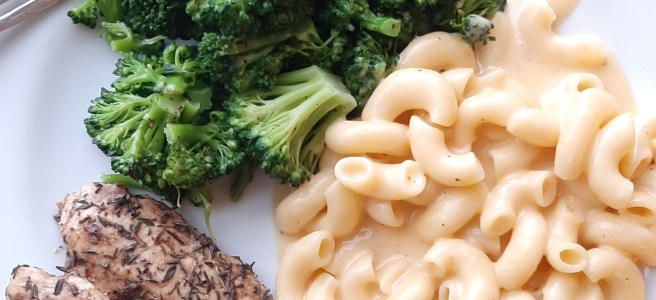
Easy Homemade Stovetop Mac & Cheese

If you’re new to cooking, there are some things you should know that will help make this recipe a success. It starts with a quality cheese sauce. When butter and flour are mixed it’s called a roux. The roux acts as a thickener for the sauce. Combined with milk and cheese, it becomes silky-smooth. This is what makes mac and cheese the ultimate comfort food. It couldn’t be accomplished by melted cheese alone. Be patient with this recipe if you’ve never made mac and cheese from scratch. It might take a couple of tries to get it to your liking.

When selecting cheese, stay away from pre-shredded varieties. They have a non-clumping ingredient to keep the cheese from clumping together in the package. Unfortunately, this ingredient causes the cheese to become very stringy when melted into the white sauce. Speaking from experience, the sauce will be a complete waste. It’ll be worth it to get a quality block of sharp cheddar cheese and grate it yourself. There are so many varieties including white cheddar that will perform well for this recipe.

Easy Homemade Stovetop Mac & Cheese Recipe

Ingredients

  • 8 oz elbow macaroni
  • 2 Tbsp unsalted butter
  • 2 Tbsp all-purpose flour
  • 1 ½ cups milk
  • 4-6 oz sharp cheddar cheese, grated
  • ½ tsp salt (optional)
  • Dash black pepper

Directions

In a large pot, cook the macaroni according to the package directions. Drain and set aside. In the same pot, melt the butter over medium heat. Whisk in the flour, stirring consistently until smooth, about 1 minute. Then slowly whisk in the milk, and salt and pepper, if desired. Stir occasionally. Simmer for about 5 minutes until the mixture thickens. Whisk in the cheese until fully melted. Stir in the cooked macaroni until thoroughly blended. Serve immediately.

The recipe makes about 6 servings. Serving size 1 cup. As a side, ½ cup.

Green Apple Dietitian tips

  • Serve this dish with steamed vegetables like broccoli or carrots or a tossed green salad
  • For a higher protein meal, serve 4-6 oz chicken or beef with mac and cheese on the side. Keep it vegetarian by serving it with sauteed squares of extra-firm tofu
  • Spice up your mac and cheese with a pinch of nutmeg, or 1 tsp mustard powder and ¼ tsp paprika
  • Add a splash of water or milk to the desired consistency if the mac and cheese dry out