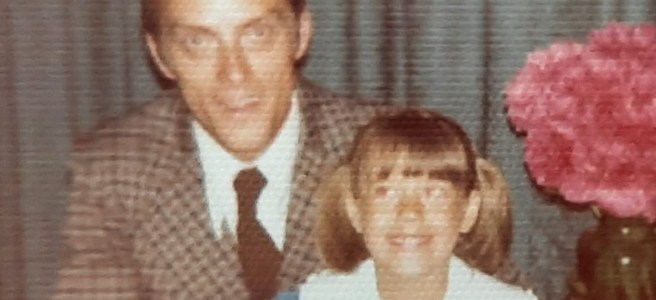
Some mornings, I wake up wishing someone would stop the Earth so I can get off. This Father’s Day morning is one of them. This year, I’m the same age my dad was when he died. He passed three months and 12 days before he turned fifty-six on Christmas Day. He always joked about how he was “ripped off” by having to share his birthday with Christmas. As a child growing up in a poor household, he got one gift for his birthday and Christmas. As a father of three, he showered us kids with way more than enough presents on Christmas morning.
If he were still around, I think he’d be proud of his daughter. A college graduate, married for 24 years, who is now heading towards retirement. It’s sad to think that if he were still around, my path in life might have been different. So, I chose to believe my accomplishments would have given him something to brag about.
My dad cared a lot about his family, but was controlling to a fault. The stories he told about his childhood illustrate why he did things his way and believed his way was the only way. He grew up with two brothers and a single mother. My grandmother suffered from alcohol abuse disorder. All I knew were bits and pieces of stories that were brought up in conversation. My mom told me my dad said he and his brothers would come home from school to find my grandma passed out. He also said how awful he felt one day when he saw his dad walking alone on the street. He hadn’t seen him for a long time and described him as a broken man. I don’t remember exactly how the conversation went, only that my dad was heartbroken.
As I saw it, during the last few years of his life, my father gave up living. He isolated himself from friends and family. His health took a turn for the worse. One of my darkest memories as a teen was visiting my dad in the ICU when a nurse asked my mother how long my father had been diabetic. My mom looked surprised and said, “I don’t know,” words she always used to deflect the harshness of my father.
Before ending up in the hospital, my dad drank 2 liters of soda every day. My mother recalled my dad saying his doctor told him he had diabetes, but he didn’t believe it. No one could tell my father anything, even trained professionals.
I always thought that my father was tough. Until one day, he caught me off guard by showing a vulnerable side. One morning, I came out of my room and found him sitting on the couch, crying in the living room. He told me he was feeling sick and hated that he couldn’t take care of our home the way he used to. He said he didn’t want to be a burden to anyone. I didn’t know what to do as my mind raced and I felt my body go numb. It was the first time I ever saw tears streaming down his face. All I could do at the time was hug him. Through the awkwardness, not many words came out of my mouth. The right words never came.
I’m sure there was cognitive impairment as the symptoms of diabetes got worse. Excessive thirst, accompanied by a craving for carbohydrates, is a classic sign that shouldn’t be ignored. It could’ve played a part in his decision to isolate himself and allow his health to decline. The day he cried in front of me also might have been the only time he tried to tell someone how he was feeling. But what’s a kid going to do?
My mom begged him to see his doctor, but he refused. I came home from high school one afternoon to my mom in a panic. She told me to help her get my dad into the car. He was noticeably incoherent and couldn’t walk without us holding him up. My mom drove him to the doctor’s office, and he advised her to take him to the emergency room right away. He was in what I believed to be a Hyperosmolar Hyperglycemic State, which needs immediate medical attention.
The doctors said a stroke and severe hyperglycemia ended his life. He also suffered gangrene in his large intestine, which was operated on, but his condition never improved. Both of us were by his side in the hospital when he passed around three in the morning. I don’t know which was worse, watching my father pass away or watching him mouthing the words “home” in the ICU while I felt helpless. There wasn’t much either of us could do.
At fifty-six, I think I know how my dad was feeling.
Rare as it was, there was a time when my dad and I found common ground. In the early eighties, HBO’s Red Skelton’s Funny Faces came on. Together, we watched the beginning monologue and shared a laugh. He appreciated that a person my age thought he was funny. Red was well past his prime but was still up on his game. I used to tease my dad about the famous heroes of his day. He would joke in response, but now I wonder if he felt hurt by it.
I remember how my dad watched his favorite entertainers fall out of favor while 80s B-rated flicks and heavy metal music of my generation became popular. Today, social media is full of memes poking fun at the big hairstyles of the eighties which illustrates that I’m no longer in the prime of my life.
It took me years to forgive my father for his controlling nature, which didn’t prepare me for a future without him. He didn’t finish high school, yet he set an example by working the better part of his life to provide for his family. He tried to do right for his health by giving up cigarettes, alcohol, and taking his blood pressure medicine.
Whenever I complained about my life as a teenager, he used to say I had it much better than he did. If he saw me unhappy, he’d say, “Act happy, and you’ll be happy.” None of that advice was helpful back then, but I understand why he said it. I’m sure there were plenty of times he had to act happy. Especially as a child on Christmas morning while opening his one gift.
It’s time to make the best of every moment.
Now that my mom is in her seventies, I cherish our time together as she reminisces about her past. My mom talks more about her side of the family. She’s answered questions about things I’ve always wanted to know. She speaks highly of the wisdom my grandpa shared with her when she was little. She has memories of sitting on her great-grandfather’s lap at the age of four. Within these stories, I learn more about myself.
Neither of my parents had much when they grew up, but they always gave me what I needed. My mom always says, “I’ve got your back.” Every day, I work hard to give her good reasons to do so.
Telling people to be healthy misses the mark.
Whenever someone blurts out, “Just eat healthier and exercise more,” and all your problems will go away, I know they don’t get it. In the field of psychology, it’s well understood that how we act is driven by how we feel and think. This off-the-cuff advice misses this complexity. It disregards a life story that correlates with the way people take care of themselves. Since we are our own worst critics, we aren’t always going to do what’s best for our bodies.
What we believe about ourselves plays a huge part in health outcomes and the aging process. Healthy habits are always within our reach if we want to work on them. Yet most of them are unsustainable. The story is always the same. I used to exercise, but now I work 60 hours a week. I lost twenty pounds but gained back thirty after my mom died.
Personal health remains at the bottom of the list in our busy society despite the attention it receives. No one wants to admit to not making it a priority. It’s easy to criticize others for neglecting their health when you don’t know the path their life is on.
We need to stop talking and listen to what others are saying. Put aside the righteousness of whatever it is you think you know. In this world, too many of us feel like we’re not being heard and feel the pressure to justify our positions. Sometimes it just is. Accepting someone’s current situation can go much further when we don’t say anything at all.

 Green Apple Dietitian